The algorithm powering billions in logistics savings isn’t deep learning, it’s a 70-year-old statistical method you’ve probably never heard of.
“Will this shipment arrive on time?” Ask any logistics manager, and you’ll see the anxiety flash across their face. For decades, answering this question involved gut instinct, historical averages, and crossed fingers. Not anymore.
Today’s leading logistics companies are making thousands of these predictions daily with 85-95% accuracy. They’re not using sophisticated neural networks or billion-parameter language models. They’re using logistic regression, a statistical technique from the 1950s that’s having its moment in the spotlight as logistics goes data-driven.
The irony is delicious. While tech companies chase the latest AI breakthroughs, logistics operators are discovering that relatively simple algorithms, applied correctly to the right problems, deliver transformative results. And logistic regression is proving to be the workhorse that makes modern logistics actually work.
Why This Matters Now
The logistics industry generates massive amounts of data, GPS coordinates, delivery timestamps, weather conditions, traffic patterns, carrier performance metrics. But historically struggled to extract value from it. Companies like Wahyd Logistics are changing that by embedding predictive analytics directly into operational workflows.
The catalyst? Most critical logistics decisions are binary: on-time or delayed, damaged or intact, accept this shipment or reject it. And binary classification happens to be exactly what logistic regression does best.
Unlike linear regression, which predicts continuous values (like “this shipment will take 4.3 hours”), logistic regression predicts probabilities of discrete outcomes (“this shipment has an 87% chance of arriving on time”). That probability becomes actionable intelligence that operations teams can use to make smarter decisions in real-time.
The Algorithm That Actually Gets Used
Here’s what makes logistic regression different from the machine learning hype cycle: it’s interpretable. When a logistic regression model predicts a shipment will be delayed, you can trace exactly why, maybe it’s the route (15% increased delay risk), the weather forecast (22% increased risk), and the carrier’s recent performance (8% increased risk).
This interpretability matters enormously in regulated industries where “the algorithm said so” isn’t an acceptable explanation for a missed delivery or rejected shipment. Logistics managers need to understand why predictions are made to trust them enough to act.
The technical foundation is elegantly simple. Logistic regression uses a sigmoid function to map input variables (distance, weather, carrier history, traffic conditions) to probability outputs between 0 and 1. The mathematics is straightforward enough to run on modest hardware, enabling real-time predictions at scale.
Speed matters too. While deep learning models might take seconds to generate predictions, logistic regression delivers results in milliseconds. When you’re routing thousands of shipments daily, those milliseconds compound into operational advantages.
Predicting What Actually Matters
Delivery delays represent the highest-impact application. Companies build models incorporating dozens of variables: route distance, historical traffic patterns, weather forecasts, carrier performance history, day of week, seasonality, even local events that might cause congestion.
The output isn’t just “delayed or on-time” but probability scores that enable nuanced decisions. A shipment with 92% on-time probability gets standard handling. One with 65% probability triggers proactive customer communication and possible route adjustments. Below 50%? The system might automatically rebook with a different carrier.
Major e-commerce platforms use these models to power their delivery guarantees. That “arrives by Tuesday” promise isn’t optimism, it’s a data-driven prediction backed by models processing millions of historical shipments.
Carrier selection offers another high-ROI application. Instead of routing based purely on cost or random assignment, smart systems predict which carriers will successfully complete specific shipments without damage. Variables include carrier track record, shipment characteristics (fragile vs. durable), route complexity, and weather conditions.
This directly connects to how businesses reduce logistics costs using AI not by finding cheaper carriers, but by reducing the expensive failures (damaged goods, late deliveries, customer complaints) that erode margins.
Damage prediction leverages similar logic. Models assess cargo fragility, packaging quality, handler experience, route roughness, and transportation mode to predict damage probability. High-risk shipments trigger additional packaging, route changes, or carrier upgrades. The same principles that help reduce damage in furniture transport apply across all cargo types when powered by predictive analytics.
One furniture logistics provider reported 40% damage reduction after implementing damage prediction models. High-risk shipments received extra padding and experienced handlers, while low-risk shipments used standard procedures optimizing protection spending where it mattered most.
The Warehouse Gets Smarter
Beyond transportation, logistic regression is transforming warehouse operations. Stockout prediction models forecast whether inventory will fall below critical levels before it happens, triggering proactive reordering. Variables include current stock levels, historical demand patterns, upcoming promotions, seasonal trends, and supplier lead times.
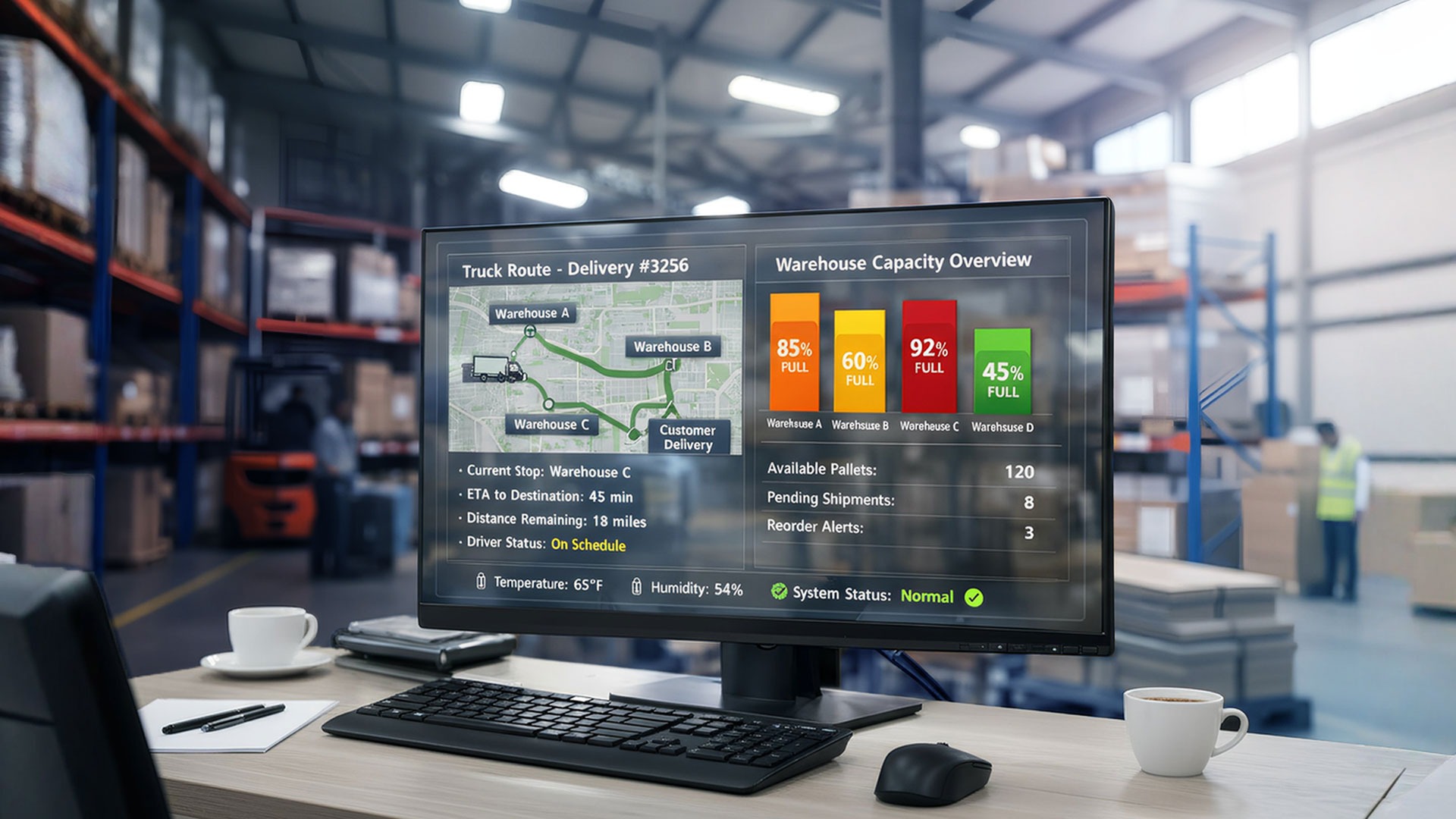
Order fulfillment success prediction helps route orders to warehouses most likely to complete them successfully. Can Warehouse A fulfill this order on time given current staffing, inventory location, and order complexity? The model generates a probability score, and orders get dynamically routed to maximize successful fulfillment.
Equipment failure prediction applies logistic regression to maintenance scheduling. Models analyze equipment sensor data vibration patterns, temperature readings, usage hours to predict failure probability. Maintenance gets scheduled proactively during low-demand periods rather than reactively when equipment breaks during peak operations.
One distribution center reduced unexpected equipment failures by 52% using predictive maintenance models, translating to fewer operational disruptions and lower maintenance costs.
Building Models That Work
The technical implementation isn’t rocket science, but it requires discipline. Data quality matters; garbage in, garbage out remains the iron law of machine learning.
Feature engineering creating meaningful variables from raw data, separates effective models from mediocre ones. Raw timestamp data becomes “day of week,” “hour of day,” “days until holiday,” and “historical traffic at this time.” GPS coordinates become “route distance,” “route complexity,” and “weather exposure.”
Handling imbalanced datasets presents a common challenge. If only 5% of shipments are damaged, a naive model could achieve 95% accuracy by predicting “not damaged” every time, technically accurate but operationally useless. Techniques like oversampling rare events, using different class weights, or adjusting probability thresholds address this.
The tooling is accessible. Python’s scikit-learn library implements logistic regression in a few lines of code. Cloud platforms like AWS SageMaker, Google Cloud AI, and Azure ML provide managed services that handle infrastructure complexity.
But technology is the easy part. The hard parts are organizational: convincing operations teams to trust predictions, integrating models into existing workflows, and maintaining performance as conditions change.
The ROI Story
The business case for logistic regression in logistics is compelling. Implementation costs are modest; mid-sized logistics providers can launch pilot projects for $50,000-150,000, including data infrastructure, model development, and integration.
Returns compound quickly. A 10% improvement in on-time delivery might increase customer retention 5-15%. A 20% reduction in damage cuts insurance claims and replacement costs proportionally. Better carrier selection reduces costs while improving quality, the rare win-win.
One regional logistics provider shared numbers: $100,000 invested in predictive analytics delivered $780,000 in first-year benefits through reduced damages, improved on-time performance, and optimized carrier spending. Second-year benefits exceeded $1.2 million as models improved and adoption spread.
What’s Coming Next
The evolution isn’t toward replacing logistic regression with more complex models, it’s toward using it more effectively as part of integrated systems.
Real-time adaptive models that update continuously as new data arrives will replace static models retrained monthly. Ensemble approaches combining multiple specialized models will handle edge cases that single models miss. Explainable AI frameworks will make predictions even more transparent, critical for regulated environments.
Integration with IoT sensors, blockchain tracking, and autonomous vehicles will provide richer data that makes predictions more accurate. But the fundamental algorithm, logistic regression will likely remain central because it works, it’s fast, and people can understand it.
The companies winning in logistics aren’t necessarily those with the most sophisticated AI. They’re the ones using proven techniques like logistic regression to make thousands of small decisions better every single day. Those improvements compound into sustainable competitive advantages that fancy algorithms alone can’t deliver.
Getting Started
If you’re in logistics and not using predictive analytics, start simple. Identify one high-impact binary decision: predicting delays, selecting carriers, forecasting stockouts. Gather 6-12 months of historical data on that decision and the factors influencing it.
Build a basic logistic regression model; you can hire a data science contractor for $5,000-10,000 to deliver a proof of concept. Measure results rigorously: did predictions beat human judgment? By how much? What’s the business impact?
If results are positive (they usually are), expand gradually. Add more use cases, improve data collection and integrate predictions deeper into operations. This incremental approach builds organizational capability while delivering measurable value at each step.
The logistics industry is entering a data-driven era where competitive advantage increasingly comes from better decisions made faster. Logistic regression won’t grab headlines like GPT-5 or autonomous vehicles, but it’s quietly powering the infrastructure that makes modern logistics work.
The question isn’t whether to embrace predictive analytics, it’s how quickly you can start extracting value from the data you’re already generating. The algorithm is proven. The tools are accessible. The ROI is measurable. What’s missing is action.